Prescribing Information (United Kingdom)
Aklief▼ 50 microgram/g cream – Prescribing Information (United Kingdom)
Please refer to SmPC before prescribing
Presentation: Aklief is presented in a multidose container with airless pump containing 75g of cream. One gram of cream contains 50 micrograms of trifarotene.
Indications: Aklief is indicated for the cutaneous treatment of Acne Vulgaris of the face and/or the trunk in patients from 12 years of age and older, when many comedones, papules and pustules are present.
Dosage and Method of administration:
Dosage
Apply a thin layer of Aklief cream to the affected areas of the face and/or trunk once a day, in the evening, on clean and dry skin.
It is recommended that the physician assesses the continued improvement of the patient after three months of treatment.
Special populations
Paediatric population and Elderly patients
The safety and efficacy of Aklief in children below 12 years old and in geriatric patients aged 65 years and above have not been established.
Renal and hepatic impairment
Aklief has not been studied in patients with renal and hepatic impairment.
Method of administration
For cutaneous use only.
Before using the pump for the first time, prime it by pressing down several times until a small amount of medicine is dispensed (up to 10 times maximum). The pump is now ready to use.
Apply a thin layer of Aklief cream once a day, to the following affected areas, in the evening, on clean and dry skin:
- forehead, nose, chin and right and left cheeks – one pump actuation should be enough
- upper trunk (i.e. reachable upper back, shoulders and chest) – two pump actuations should be enough
- upper trunk (i.e. reachable upper back, shoulders and chest) – two pump actuations should be enough
Patients should be instructed to avoid contact with the eyes, eyelids, lips and mucous membranes and to wash their hands after applying the medicinal product.
Contraindications:
• Pregnancy
• Women planning a pregnancy
• Hypersensitivity to the active substance or to any of the excipients.
Precautions and Warnings:
To mitigate the risk of erythema, scaling, dryness, and stinging/burning, patients should be instructed to use a moisturizer from the initiation of treatment (while allowing sufficient time before and after the application of Aklief cream to allow the skin to dry), and, if appropriate, reduce the frequency of application of Aklief cream, or suspend use temporarily. If severe reactions persist the treatment may be discontinued.
The product should not be applied to cuts, abrasions, eczematous or sunburned skin.
As with other retinoids, use of “waxing” as a depilatory method should be avoided on skin treated with Aklief.
If a reaction suggesting sensitivity to any component of the formula occurs, use should be discontinued. Caution should be exercised if cosmetics or acne medications with desquamative, irritant or drying effects are concomitantly used with the medicinal product, as they may produce additive irritant effects.
Aklief should not come into contact with the eyes, eyelids, lips, or mucous membranes. If the product enters the eye, wash immediately and abundantly with lukewarm water.
Excessive exposure to sunlight, including sunlamps or phototherapy should be avoided during the treatment. Use of a broad-spectrum, water-resistant sunscreen with a Sun Protection Factor (SPF) of 30 or higher and protective clothing over treated areas is recommended when exposure cannot be avoided.
This product contains propylene glycol (E1520) that may cause skin irritation. Aklief also contains 50 mg alcohol (ethanol) in each gram which is equivalent to 5% w/w. It may cause burning sensation on damaged skin.
Pregnancy, Breast-feeding and Fertility:
Orally administered retinoids have been associated with congenital abnormalities. When used in accordance with the prescribing information, topically administered retinoids are generally assumed to result into low systemic exposure due to minimal dermal absorption. However, there could be individual factors (e.g. damaged skin barrier, excessive use) that contribute to an increased systemic exposure.
Pregnancy
Aklief is contraindicated during pregnancy or in women planning a pregnancy. If the product is used during pregnancy, or if the patient becomes pregnant while taking this drug, treatment should be discontinued.
Breast-feeding
A risk to the suckling child cannot be excluded. A decision must be made whether to discontinue breast-feeding or to discontinue/abstain from Aklief therapy taking into account the benefit of breast-feeding for the child and the benefit of therapy for the woman. To avoid the risk of ingestion by, and/or contact exposure of, an infant, nursing women should not apply trifarotene cream to the chest or breast area.
Fertility
No human fertility studies were conducted with Aklief. After oral administration of trifarotene to dogs, findings of Germ cell degeneration were observed
Effects on ability to drive and use machines:
Aklief has no or negligible influence on the ability to drive and use machines.
Undesirable Effects:
The most “commonly” reported adverse reactions (occurring in ≥1/100 to <1/10 patients) of application site irritation, application site pruritus and sunburn (see table below) occurred in 1.2% to 6.5% of patients treated with Aklief cream in clinical studies.
Table of “commonly” reported adverse reactions of patients treated with Aklief cream in clinical studies
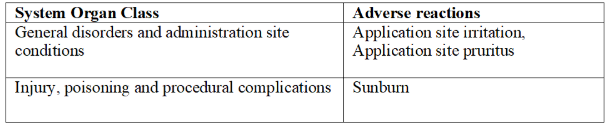
Prescribers should consult the Summary of Product Characteristics (SmPC) in relation to the uncommon (≥1/1,000 to <1/100) and rarely occurring (≥1/10,000 to <1/1,000) adverse reactions as reported in these studies.
Packaging Quantities and Cost: 1 x 75g multidose container with airless pump; £ 27.75 excluding VAT
Marketing Authorisation Number: PL 10590/0071
Legal Category: POM
Marketing Authorisation Holder:
Galderma (UK) Limited, Evergreen House North, Grafton Place, London, NW1 2DX, United Kingdom
Further information is available from:
Galderma (UK) Ltd, Evergreen House North, Grafton Place, London, NW1 2DX, United Kingdom
Telephone: +44 (0)300 3035674
Date of Revision: July 2023
| Adverse events should be reported. Reporting forms and information can be found at www.mhra.gov.uk/yellowcard or search for MHRA Yellow Card in the Google Play or Apple App Store. Adverse events should also be reported to Galderma (UK) Ltd: E-mail: [email protected] Tel: +44 (0)300 3035674 |